
If you looked up at the Moon on Thailand's Visakha-puja day (1 June 2558) this year, you would have noticed that the Moon was not quite full. At my place in Dreamland, last night (3 June 2015) was the Full Moon. Now if you looked up the calendar, you would see that 1 June 2558 was in Lunar calendar the Full Moon of the Seventh month ( Visak Day is supposed to be on the Full Moon of the Sixth lunar month of the year). But if you looked the Lunar calendar on the Internet, then you could see something like:
Full Moon in Thailand: Mon 1 June 2015
Full Moon in USA: Tue 2 Jun 2015, 12:19 P.M.
Full Moon in AUS: Wed 3 Jun 2015, 02:19
So, when is the Full Moon in June this year? Really, what we have looked up did not make sense. Just like a rabbit on the Moon. Look at the picture below. I have a proof that there is a rabbit in every peanut!
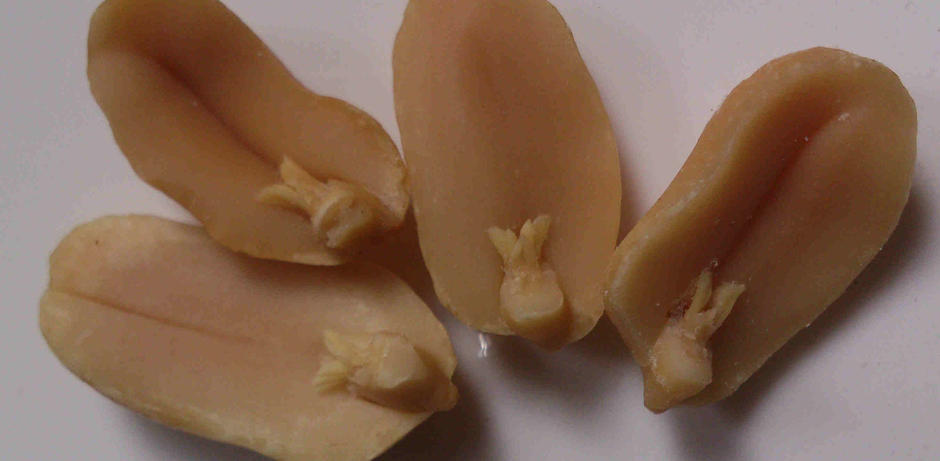
Many questions like: How do we calculate the Lunar calendar? Does our calculation match up with the real Moon in 'our sky' (remember the arrive 1 day late in USA sky)? Is it time to re-adjust our Lunar calendar so we can have the day for Visakha-pucha on the Full Moon of the Sixth Lunar month? (A real mess this year!) Perhaps you can help me here ;-)
What more is - this year we are having 2 Eighth Lunar months (เดือน ๘ สองหน -- look up a calendar please). Enough to throw the Vassa (วันเข้าพรรษา) into another confusion.
Thai teachers, wouldn't this year 2558 make an interesting subject for school study and report?
No, I don't ask astrologers or horoscopers, I have enough to think about, But if you really must... ;-)
[Added for learners of English]
Just a few words of English about the Moon (note the big 'M')
- New Moon แรม ๑๕ ค่ำ
- Waxing Moon ข้างขึ้น
- First (half) Moon ขึ้น ๘ ค่ำ
- Full Moon วันเพ็ญ ขึ้น ๑๕ ค่ำ
- Waning Moon ข้างแรม
- Last (half) Moon แรม ๘ ค่ำ
- Moon rises พระจันทร์ขึ้น (as for Sun rises)
- Moon sets พระจันทร์ตก (as for Sun sets)
- Blue Moon - the second full Moon in a Gregorian calendar month; blue Moon can't happen in February (why?); the next blue Moon is on 31 July 2558; on very rare occasions the Moon can appear 'blue' too.
From http://stardate.org/nightsky/moon
The most common names used in North America include:
January -- Moon after Yule
February -- Snow Moon
March -- Sap Moon
April -- Grass Moon
May -- Planting Moon
June -- Honey Moon
July -- Thunder Moon
August -- Grain Moon
September -- Fruit Moon (or Harvest Moon)
October -- Hunter's Moon (or Harvest Moon)
November -- Frosty Moon
December -- Moon before Yule
Note: The full Moon of June is known as the Flower Moon, Strawberry Moon, Rose Moon, or Honey Moon.


Happy Visakha day
I like your full moon.555
Thanks ขจิต ฝอยทอง: The Moon is ours (not just mine or yours ;-). It is quite odd, isn't it - to have a Visak (Visakha-puja day) on the full Moon of the 7th month this year; after roting for years that Visak is on the full Moon of the 6th lunar month? I have just added a few more words in English about the Moon. I hope these words are useful to you and your students.
ปั่นๆ จักรยานไป ปั่นๆ จักรยานกัน
ปั่นด้วยใจที่แสนชื่นบาน
ให้โลกสวย สวยงามวิ่งผ่านสองล้อเรา
Huh? Happy biking Dr. Ple : Looks like you have a good biking track -- no car traffic or kids playing in the street, only the shadow of spider webs errh phone (land) lines and (electric) power cables ;-)
Don't forget to look up and enjoy ..the next blue Moon is on 31 July 2558...
Let me add some more info as comment and ask this question once more.
"Why the full Moon days in Thailand (for important Buddhist occasions) are NOT the same as the full Moon say as observed/predicted by observatories around the world?"
Some questions and answers:
http://resources.woodlands-junior.kent.sch.uk/time... :
People in different hemispheres see the moon in a slightly different way.
In the Southern Hemisphere, people see the moon 'upside down' so the side which is shining (sunlit) seems the opposite from the Northern Hemisphere.
Countries in the different hemispheres see the Moon from a completely different vantage point from each other.
In the northern hemisphere the first quarter looks like a growing D, while in the southern hemisphere it looks like a C.
In the northern hemisphere the last quarter looks like a C, while in the southern hemisphere looks like a D.
[To memorise N-DOC = Northern hemisphere - first quarter looks like D, fullmoon like O, last quarter like C; and S-COD = Southern hemishere - first quarter looks like C, full moon like O, last quarter like D]
"Do you see different phases of the Moon around the world?"
Asked by Jonathan O'Callaghan, 13 December 2012
"Does the Moon look different from the northern and southern hemispheres?"
Asked by Brian Baur
The phases of the Moon that we see are caused by the relative positions of the Sun, Moon and Earth. The phase of the Moon is defined by the proportion of the Moon lit up by the Sun that is visible from Earth. Over the 24 hour period that it takes for the Earth to spin so that all areas can see the Moon, these relative positions wouldn’t alter enough to see a different phase of the Moon around the world.
[My Comment: The Moon phases are "visually" the same around the world (but at different "World Time"). That is the Moon looks full in a Thailand night also looks full in Canada or USA but the local time will be some 9 hours later than Thailand time.]
However the Moon does not look completely identical from every location on Earth; depending how far South or North you are (your latitudinal position) the Moon appears to be rotated. In the northern hemisphere the sunlit part of the Moon travels from right to left while from the southern hemisphere the light appears to travel from left to right. This is simply down to the differing angles you are observing the Moon from.
Answered by Megan Whewell, Education Team Presenter for the National Space Centre
Now another question: Who (or what oraganizarion) in Thailand determines what day is Visakha day,? Which day is Aasalaha day?... Why were they NOT the full moon days in 2558?