
ปาล์มน้ำมัน พืชแห่งพลังงานทดแทน
ปาล์มน้ำมัน Elaeis guineensis Jacq. เป็นพืชน้ำมันอุตสาหกรรมที่มีความสำคัญทางเศรษฐกิจในระดับโลก ให้ผลผลิตน้ำมันต่อหน่วยพื้นที่มากกว่าพืชน้ำมันชนิดอื่นๆ เป็นพืชที่มีศักยภาพในการแข่งขันสูงกว่าพืชน้ำมันชนิดอื่นทั้งด้านการผลิตและการตลาด ส่วนแบ่งการผลิตน้ำมันปาล์มต่อน้ำมันพืชของโลกเพิ่มสูงขึ้นอย่างต่อเนื่องและรวดเร็ว ประเทศผู้ผลิตที่สำคัญ คือ มาเลเซีย และอินโดนีเซีย มีการนำมาแปรรูปผลิตภัณฑ์ต่างๆ ได้แก่ มาการีน ไขมันและน้ำมันทอด วิตามินอี เนยขาว วานาสปาติ ครีมเทียม อุตสาหกรรมอาหาร สบู่ หรือใช้แทนน้ำมันดีเซล ปัญหาที่พบในกระบวนการผลิตปาล์ม คือ การปลูกปาล์มน้ำมันที่เก็บเมล็ดจากโคนต้นปาล์ม ซึ่งเป็นพันธุ์ปลอม ทำให้ปาล์มน้ำมันที่ปลูกมีความแปรปรวนทางพันธุกรรมสูง ให้ผลผลิตทะลายสดต่อไร่ต่อปีต่ำกว่าการปลูกปาล์มพันธุ์ดี ส่งผลเสียหายต่อเศรษฐกิจโดยรวม การผลิตต้นกล้าปาล์มน้ำมันคุณภาพสูง มีมาตรฐานปลอดโรค เป็นเรื่องที่สำคัญยิ่ง
การโคลนนิ่งพืช (Plant Cloning) เป็นเทคโนโลยีใหม่ที่มีความสำคัญต่อการขยายพันธุ์พืชปลอดโรค ผลิตต้นกล้าที่มีความตรงตามสายพันธุ์ ได้ปริมาณมากในระยะเวลาอันรวดเร็ว คำว่าโคลนนิ่งพืชเป็นคำที่มีความหมายเหมือนคำว่า การเพาะเลี้ยงเนื้อเยื่อพืช ปัจจุบัน ความรู้เรื่องการเพาะเลี้ยงเนื้อเยื่อปาล์มน้ำมันในต่างประเทศมีความก้าวหน้า และสามารถนำมาประยุกต์ใช้ในเชิงการค้า เช่น บริษัท ASD ผลิตปาล์มน้ำมันในคอสตาริก้าได้ผลิตต้นกล้าปาล์มน้ำมันพันธุ์คอมแพ็ค ส่งจำหน่ายไปทั่วโลก
**************
การประชุมทางวิชาการ ครั้งที่ 48
มหาวิทยาลัยเกษตรศาสตร์
บางเขน
3-5 กุมภาพันธ์ 2553
การเพิ่มปริมาณยอดของปาล์มน้ำมัน
โดยใช้ส่วนปลายยอด
Shoot multiplication of Oil palm
(Elaeis guineensis Jacq.) by Shoot tip culture
จิระศักดิ์ วิชาสวัสดิ์1 ศิริชัย อุ่นศรีส่ง2 สมพร มีแสงแก้ว1
ประสาทพร กออวยชัย1 และ ปณิดา กันถาด1
Jirasak Wichasawasdi1, Sirichai Unsrisong2, Somphon Meesangkaew1,
Prasatporn Koauychai1, and Panida Kuntud1
บทคัดย่อ
การเปรียบเทียบผลของอาหารแข็งและอาหารเหลว สูตร OPM ที่มีต่อการเติบโตของชิ้นส่วนปลายยอดในสภาพปลอดเชื้อ เมื่อเลี้ยงนาน 190 วัน พบว่า อาหารเหลว ทำให้มีจำนวนใบมากที่สุด 6.4±6.9 ใบ ซึ่งแตกต่างกันอย่างมีนัยสำคัญยิ่งทางสถิติ ที่ระดับความเชื่อมั่น 95% หลังจากนั้นได้นำยอดที่เกิดขึ้นในอาหารเหลว(จากการทดลองที่ 1) จำนวน 20 ตัวอย่าง เลี้ยงในอาหารเหลวสูตร VW นาน 147 วัน พบว่า มีการเพิ่มปริมาณยอด เฉลี่ย 18±14.16 ยอดต่อชิ้นส่วน
ABSTRACT
A comparison of the OPM liquid-medium and OPM solid-medium cultured the Oil palm shoot tips for a period of 190 days. According to the paired t-test, means are significantly different at 95% level of confidence. With the shown result, the OPM liquid-medium, distinctively, has a very high effective to the shoot tips growth with the maximum leaf number of 6.4±6.9 leaves. Subsequently, we have continuously extended are our 2nd experiment by transferring the growth shoot tips (from 1st experiment), to culture in the VW liquid-medium for other 147 days. There for, we randomly cultured 20 samples of the growth OPM liquid-medium shoot tip for the experiment. The result shown that, there is a high productive of multiple- shoot from each sample. In which, There are 18±14.16 new shoot growth clusterly amongst a single sample.
Keywords: Elaeis guineensis Jacq., Tissue culture, Shoot multiplication, Shoot tips cultur, liquid medium
J, Wichasawasdi: [email protected]
________________________________________________________________
1มหาวิทยาลัยแม่โจ้-ชุมพร, ชุมพร
2 ภาควิชาพืชไร่, คณะผลิตกรรมการเกษตร, มหาวิทยาลัยแม่โจ้.
1 Maejo University at Chumphon, Chumphon, Thailand
2 Department of Agronomy, Faculty of Agricultural Production, Maejo University. Thailand
INTRODUCTION
Oil palm (Elaeis guineensis Jacq.), a perennial allogamous monocotyledonous tree, give the highest yield of oil per hectare of any oil-producing crop (Gorret et al.,2004). Oil palm is a very important commercial crop in the world.
In vitro multiplication has been applied to crop improvement using many methods (Chukwuemeka et al., 2005; Duval et al.,1993).Clonal propagation of oil palm has been studies for many years as a potential way to develop high-yielding collection while circumventing the long generation time required with traditional breeding techniques. In 1991, the first regenerable oil palm embryogenic cell suspension cultures were obtained from Oil palm leaf-derived calli( de Touchet et al.,1991) Later, mature zygotic embryo excised from fruits were used to generate friable embryogenic tissue and to establish embryogenic. Although these two protocols were successful for estabilishing single somatic embryos from embryogenic suspension culture, the regeneration rate into plantlets was poor. This issue was overcome by Aberlenc-Bertossi et al., (1999), who developed a protocol to improve the quality of shoot formation (Gorret et al., 2004).
The aim of this research is to set up for oil palm shoot multiplication through in vitro culture. Data obtained from the growth of oil palm tissue in the liquid medium suggested the importance of key parameters, and preliminary optimization studies were carried out using response surface experiment designs.
METERIALS AND METHODS
Experiment 1. A comparison of the liquid medium and the solid medium cultured the Shoot tips.
Immature embryos of Oil palm were excised from Immature seed and surface sterilized by soaking in 70% ethanol for 5 min and in 10% Clorox containing a wetting agent “Tween20” for 10 min followed by three rinses in sterile distilled water. The embryos were cultured on modified MS medium (Murashige and Skoog,1962) with 3% sucrose and 0.7% agar, pH 5.6. Embryo cultures were incubated at 25±2°C under dark and light condition illuminated by cool-white fluorescent light with16 hrs photoperiod for 45 days. After 45 days of culture, the shoot tips of embryos were excised and transfer to the both OPM mediums (solid medium and liquid medium; see the components of the OPM medium in appendix). The both OPM mediums supplemented with 0.46 mg/lBAP(Benzylaminopurine) plus 0.01 mg/l IAA(Indoleacetic acid), 3 ml/l coconut water (CW.), Three percent of sucrose and 0.7 % (w/v) of Difco agar were also added to the solid medium, but the OPM liquid medium without agar. The pH of medium was adjusted to 5.6 prior to autoclaving at 1.4 Kg cm-2 for 20 min. The experiment was set as two treatments (20 explants/treatment) for comparison of mean (P<0.05 by the one-sample t-test).
Shoot tip cultures were incubated without a shaker (for solid medium) and with a shaker (for liquid medium; 120 rpm) at 25±2°C under dark and light condition for other 190 days. After 190 days of culture, the number of leaves, shoot length and diameter of explants were recorded to determine the optimum medium for shoot multiplication from the shoot tips.
Experiment 2. Influence of liquid VW medium for shoot regeneration
The cluster shoot or multiple shoot (from the 1st experiment ) of 0.7-1 cms diameter were randomly collected and transferring to the regeneration medium consisted of VW (Vacin and Went,1949) medium, supplemented with 20 g/l sucrose, 150 ml/l coconut water at the adjusted pH of 4.8-5.0. The cultures were maintained under alternate 16/8 h light/dark at 25±2°C for a period of 147 days. The width of cluster shoot, cluster shoot length, number of cluster shoot, new shoot length and number of leaflets (Leaflets borne on the parts of cluster shoot) were recorded and the percentages of leaflets induction were calculated (use 20 samples).
RESULTS AND DISCUSSION
Experiment 1. A comparison of the liquid medium and the solid medium cultured the Shoot tips.
Shoot tip of oil palm cultured on the OPM medium (the solid medium and the liquid medium) supplemented with 0.46 mg/l BAP plus 0.01 mg/l IAA after 190 days of culture to improve multiplication and proliferation of cluster shoot. A comparison of the OPM liquid medium and the OPM solid medium cultured the shoot tips for a period of 190 days. According to the paired t-test, means (number of leaf) are significantly different at 95% level of confidence. With the shown result, the OPM liquid medium, distinctively, has a very high effective to the shoot tips growth with the maximum leaf number of 6.4 ± 6.9 leaves. On the other hand there are not much different to the growth of shoot length and diameter is cultured with both OPM mediums (Table 1).
The liquid medium allows the close contact with the tissue which stimulates and facilitates the uptake of nutrients and hormones, leading to better shoot growth (Shakti et al., 2007; Othmani et al., 2009). Continuous shaking promotes lesser expression of apical dominance which generally leads to proliferation of axillary buds (Shakti et al., 2007). This result, with in the shake culture conditions, the growth and multiplication rate of shoot is enhanced by forced aeration, since continuous shaking of medium provides ample oxygen supply to the tissue which ultimately leads to their faster growth (Shakti et al., 2007; Othmani et al., 2009).
As in the case of date palm (phoenix dactylifera L.); it was found that In order to improve multiplication and proliferation of shoot clusters, shoot clusters were transferred into liquid proliferation medium. The culture of shoot clusters in Temporary immersion bioreactor (TIB) with MS liquid medium containing NAA, BAP and kinetin has clearly improved the yield regenerated shoots (Othamani et al., 2009).The addition of BAP during development was found to induce shoot apex differentiation (Aberlenc-Bertossi et al., 1999).
Table 1 Number of leaf, Shoot length and Diameter of shoots after 190 days in oil palm shoot multiplication in the solid medium and liquid medium.
|
Medium |
Number of leaf (leave) |
Shoot length (cm.) |
Diameter of |
|
OPM solid medium |
1.85 ± 0.92 b1 |
4.30 ± 2.26 a |
0.91 ± 0.28 a |
|
OPM liquid medium |
6.38 ± 6.94 a |
3.85 ± 1.48 a |
0.76 ± 0.41 a |
|
t-test |
2.89 |
0.74 |
1.35 |
|
|
* * |
ns |
ns |
|
%CV. |
120.29 |
47.01 |
42.16 |
1 Means within column followed by the same letter are not significantly different at 95% level of confidence by T-test
± values represent the standard deviation (mean±S.D.)
Experiment 2. Influence of liquid VW medium for shoot regeneration
Subsequently, we have continuously extended are our 2nd experiment by transferring the growth OPM liquid medium shoot tips (from the 1st experiment), to culture in the VW liquid medium for other 147 days, Due to we designed not to in vitro culture the growth OPM solid medium shoot tips, as it has a very slightly increased of the leaf numbers.
There for, we randomly cultured 20 samples of the growth OPM liquid-medium shoot tip for the experiment. With our observation on the 2nd experiment, there is a high productive of multiple- shoot from each sample. In which, There are 18±14.16 new shoot growth clusterly amongst a single sample. Each cluster, there are 1.5±0.8 cms of average length on new shoots, and 4.17±0.6 cms of shoot length, together with an approximately 25±18 leaves of leaflet. (Table 2)
This result agrees with the data reported by de Touchet et al. (1991) for oil palm flask cultures, Shakti et al. (2007) and Gorret et al.(2004) for oil palm tissue cultures utilizing liquid medium with bioreactor, as well as for other crops such as date palm (Othmani et al, 2009; Chukwuemeka et al., 2005; Tisserat, 1984) coffee, pineapple, tea, banana and apple (Othmani et al., 2009).The yield of somatic embryos produced in liquid medium were shown to be greater than solid medium(Othmani et al., 2009; Duval et al., 1993). The Oil palm can be vegetatively propagated by in vitro culture. Experiments with the oil palm had some promising results, viz the formation of a juvenile shoot (Staritsky et al., 1970; Teixeira et al.,1995; Wong et al.; 1997).
Table 2 The width of cluster shoot, cluster shoot length, number of cluster shoot, new shoot length, percentage leaflet and number of leaflet from the shoot tips cultured in OPM liquid medium during 190 days, and transfer to the VW medium during 147 days.
|
Cluster shoot characteristic |
Culture Medium and Day of culturing |
|||
|
OPM 190 days |
OPM 190 days |
OPM 190 days |
average |
|
|
width of cluster shoot (cm.) |
1.06 ± 0.51 |
1.63 ± 1.20 |
2.98 ± 1.18 |
2.0 |
|
cluster shoot length (cm.) |
2.11 ± 0.76 |
3.05 ± 1.08 |
4.17 ± 0.60 |
3.1 |
|
number of cluster shoot (shoot) |
6.30 ± 11.36 |
9.69 ± 12.15 |
18 ± 14.16 |
11.31 |
|
new shoot length (cm.) |
0.75 ± 0.87 |
0.83 ± 0.64 |
1.45 ± 0.81 |
1.0 |
|
Percentage of leaflet (%) |
70 |
92 |
100 |
87.3 |
|
number of leaflet (leaf) |
0 |
51.38 ± 102.13 |
25.5 ± 18.36 |
25.6 |
CONCLUSION
In vitro multiplication, the methods used are varied and have been successful in many countries although refinements are in many cases still being made. We have successfully used shoot tips as sources of explants for oil palm in vitro organogenesis which has the advantage of shoot multiplication with the liquid medium. The shoot tips culture technique is also sometimes applied in the coconut and date palm (Verdil et al., 1992; Hadrami et al., 1995).
Other experimental designs are underway to the effect of medium components for root induction and also to study the effect of process conditions such as hormones and minerals. The gathering of all this information will allow improvements in the culture of oil palm in shaker or bioreactors for micropropagation, conservation and genetic engineering of this species.
ACKNOWLEDGEMENTS
This research was financially supported by Office of Agricultural Research and Extension, Maejo University.
LITERATURE CITED
Aberlenc-Bertossi, F., M. Noirot and Y.Duval. 1999. BA enhances
the
germination of oil palm somatic
embryos derived from embryogenic
suspension cultures. Plant
cell, Tissue and Organ Culture. Springer
Netherlands. 56 (1): 53 - 57.
Chukwuemeka, R.E., A.Peter and A.Omorefe. 2005. Somatic
embryogenesis
in date palm(Phoenix
dactylifera L.) from apical meristem tissues from
‘zebia’ and ‘loko’ landraces.
African Journal of Biotechnology. 4 (3):
244 - 246.
de Touchet, B., Y.Duval and C. Pannetier. 1991. Plant
regeneration from
embryogenic suspension
culture of oil palm (Elaeis guineensis Jacq.).
Plant Cell
Rep.10: 529 - 532.
Duval,Y., A. Rival, J.L.Verdeil and J. Buffard-Morel.1993.
Advances in oil
palm and coconut
micropropagation, pp.106 - 116. In Proceedings
of
the Southeast Asian
Regional Workshop on Propagation
Techniques for
Commercial crops of the tropics. Monpellier,
France.
Hadrami, I., R. Cheikh and M. Baaziz. 1995. Somatic
embryogenesis and
plant regeneration from
shoot-tip explants in Phoenix dactylifera L.
Biologiaplantarum. 37 (2): 205 - 211.
Othmani, A., C.Bayoudh, N. Drira and M.Trifi. 2009. In
vitro cloning of date
palm Phoenix
dactylifera L., cv. Degletbey by using embryogenic
suspension and temporary
immersion bioreactor (TIB). Biotechnol.
and Biotechnol.
EQ. 1181 - 1188.
Shakti, M., K.G. Manoj, K.K. Arun and N.M. Bhatendu. 2007.
Efficiency of
liquid culture systems
over conventional micropropagation: A progress
to wards
commercialization. African Journal of
Biotechnology. 6
(13): 1484 - 1492.
Staritsky, G. 2005. Tissue culture of the Oil palm (Elaeis
guineensis Jacq.) as
a tool for its vegetative
propagation. Euphytica J. 19 (3): 288 - 292.
Teixeira, J.B., M.R. Sondahl, T. Nakamura and E.G. Kirby.
1995.
Establishment of oil
palm cell suspensions and plant regeneration.
Plant Cell Tissue and
Organ Culture. Kluwer Academic Publishers.
Netherlands. 40: 105 -
111.
Tisserat, B.1984. Propagation of date palms by shoot tip
cultures.
Horticultural
Science.19: 230 - 231.
Verdel, J.L., C. Huet, F. Grosdemanges, A. Rival and J.
Buffard – Morel.
1992.
Embryogenese Somatique du cocotier ( Cocos
nucifera L.):
Obten de plusieurs
clones de vitroplants. Oleagineux. 47: 465 -
469.
Wong, G., C.C.Tan and A.C. Soh. 1997. Large scale propagation of
oil palm
clones -
experiences to date. Hort. Biotech. In Vitro Cult.
and
Breeding.
649 - 658.
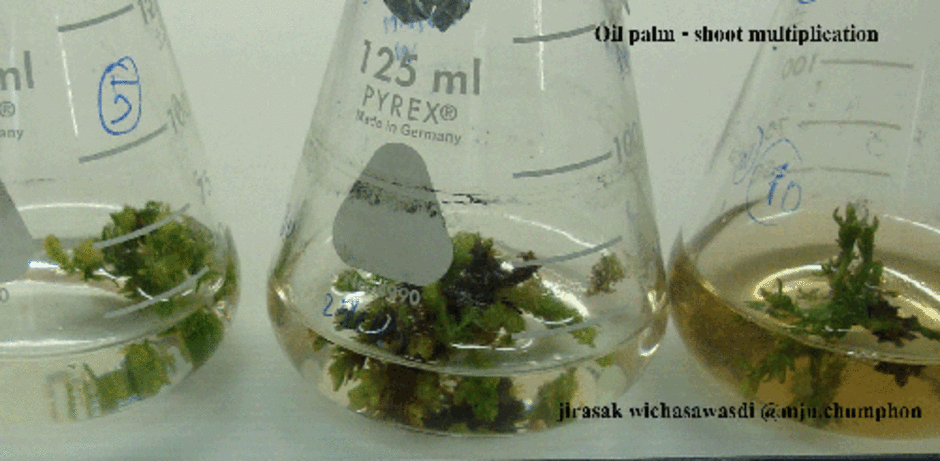
งานวิจัยการเพิ่มปริมาณยอดปาล์มน้ำมันโดยใช้ส่วนปลายยอดนี้ ได้ศึกษาวิธีการเพิ่มปริมาณยอดอ่อนให้ได้ปริมาณมาก (shoot multiplication) ภายใต้สภาพเพาะเลี้ยงเนื้อเยื่อ เพื่อเป็นฐานข้อมูลสำหรับงานพันธุวิศกรรม และการปรับปรุงพันธุ์ปาล์มน้ำมันต่อไป ผลการวิจัยพบว่า การเลี้ยงส่วนปลายยอดหรือเมอริสเต็ม อาหารเหลวสูตรใหม่ คือ สูตร OPM ที่ดัดแปลงจากสูตร MS (1962) ร่วมกับสูตร VW (1949) ทำให้สามารถเกิดกลุ่มยอดได้เฉลี่ย 18 ยอด /ชิ้นส่วน แล้วจึงนำยอดที่ได้ดังกล่าวซึ่งมีความปลอดโรค ชักนำให้เกิดราก ( root induction ) และนำออกปลูกต่อไป แนวทางวิจัยเรื่องนี้ คาดว่าสามารถนำไปประยุกต์ใช้กับพืชชนิดอื่นๆ ที่อยู่ในวงศ์ปาล์ม เช่น มะพร้าวกะทิ อินทผาลัม ฯลฯ รวมทั้งอาจประยุกต์ใช้ร่วมกับเทคนิคไบโอรีแอคเตอร์ เพื่อให้ได้ต้นกล้าปาล์มน้ำมันในปริมาณมากในเวลาอันรวดเร็ว ปราศจากเชื้อโรค และขยายผลเชิงการค้าต่อไปในอนาคต...


อยากได้พันธุ์ปาล์ ชื้อได้ที่ไหน เด็กอุบลราชธานี
สวัสดีครับ คุณเด็กอุบลฯ
สำหรับ แหล่งจำหน่ายปาล์มน้ำมันพันธุ์ดี มีหลายแหล่งครับ แบ่งเป็น 2 ประเภท
1 แหล่งจำหน่ายภาครัฐบาล ที่ศูนย์วิจัยปาล์มน้ำมัน สุราษฎร์ธานี จ.สุราษฎร์ธานี
มีปาล์มพันธุ์สุราษฎร์ธานี ให้ผลผลิตดี เหมาะกับการปลูกในภาคใต้ของประเทศไทย
2. แหล่งจำหน่ายภาคเอกชน ที่มีใบรับรองสถานที่ผลิตกล้าปาล์มจากกระทรวงเกษตรฯ
เช่น บริษัทอาร์แอนด์ดี เกษตรพัฒนา อ.ละแม จ.ชุมพร
บ.ยูนิวานิช จ.กระบี่
บ. ซีพี พันธุ์ โกลดเด้น เทอเนอร่า
สำหรับการปลูกในภาคอีสาน ควรปลูกใกล้แหล่งน้ำ ลำคลอง เนื่องจากปาล์มน้ำมันต้องการน้ำเพื่อการสร้างอาหารและดำรงชีวิตในปริมาณมาก
ภาคเอกชนที่ผลิตกล้าและเมล็ดปาล์มน้ำมันเพื่อจำหน่ายเชิงการค้า มีหลายแหล่งมากครับ ขอยกตัวอย่างนะครับ
1. บ.ซีพี ผลิตกล้าและเมล็ดพันธุ์ ชื่อ พันธุ์ปาล์มลูกผสม CP GOLDEN TENERA ค้นข้อมูลที่ http://www.cpcrop.com/
2. บ.ยูนิวานิชน้ำมันปาล์ม (UVAN) จ.กระบี่ Univanich Palm Oil Public Company Ltd., http://univanich.com/
http://www.thaibiogas.net/th/node/299
3. บ.ชุมพร อุตสาหกรรมน้ำมันปาล์ม จำกัด Chumporn Palm Oil Industry Public Company Limited
http://www.cpi-th.com/th/home.php
4. บ.อาร์แอนดี เกษตรพัฒนา จำกัด อ.สวี และ อ.ละแม จ.ชุมพร จำหน่ายกล้าปาล์มน้ำมันเพาะเลี้ยงเนื้อเยื่อ พันธุ์ดีโดยนำเข้าพันธุ์จาก บ. ASD ประเทศคอสตาริก้า http://www.cospat.com/MaejoProve.html
ลองศึกษาข้อมูลเพิ่มเติมจากสื่ออื่นๆ เอกสารเผยแพร่ หนังสือ และตำราต่างๆ หรือสอบถามเจ้าหน้าที่บริษัทนะครับ ...หากมีประชุมวิชาการเกี่ยวกับปาล์มน้ำมัน ก็แนะนำให้เข้ารับฟังข้อมูลประกอบการตัดสินใจครับ
การเพาะเลี้ยงเนื้อเยื่อปาล์มน้ำมัน ในต่างประเทศมีรายงานประสบความสำเร็จในหลายๆ ประเทศ เช่น คอสตาริกา มาเลเซีย ฯลฯ สำหรับประเทศไทยนั้นยังต้องมีการพัฒนาเทคนิควิธีเหล่านี้ให้มีศักยภาพมากยิ่งขึ้น เพื่อให้สามารถขยายผลเชิงการค้าได้ และสร้างองค์ความรู้ใหม่ๆ โดยนักวิจัยของประเทศไทย...
ถ้าผมต้องการขยายพันธุ์ปาล์มเพื่อไม่ให้กลายพันธุ์ ควรทำยังไงคับ