
การตรวจวัดฝุ่นแอสเบสตอสในอากาศ
Personal Sampling for Air Contaminants
ข้อมูลจาก OSHA , Department of Labor, USA
Collect samples for asbestos using 0.8-µm, 25-mm diameter MCEF cassettes which have been specially designated by the manufacturer for asbestos analysis. The filters must be contained in an electrically conductive cassette assembly that includes a 50-mm extension cowl (see Figure II: 1-23). Ensure that the bottom joint (between the extension and the conical black piece) of the cassette is sealed tightly with a shrink band or electrical tape. Make certain that the cassette does not leak. Position the open face of the cassette down to minimize contamination.
Use a flow rate in the range of 0.5 to 5 L/min. One liter per minute is suggested for general sampling. For office environments, use flow rates of up to 5 L/min. Do not use nylon or stainless steel adapters if in-line calibration (Figure II: 1-10 and Figure II: 1-12) is done. Do not use the same filter cassette intended to be used for field sampling for sampling pump calibration. Sample for as long a time as possible without overloading (obscuring) the filter because overloading can lead to an unreadable sample (see the discussion on filter overloading in the General Monitoring Requirements and Guidelines, Sampling Protocol section of this document). Instruct the employee to avoid knocking the cassette and, if possible, to avoid using a compressed–air source that might dislodge the collected contaminant while sampling.
Approximately 10% of all samples submitted should be blanks, with a minimum of two blanks in all cases.
Where possible, collect and submit a bulk sample of the material suspected to be in the air. Submit approximately 0.5 to 1 gram of material in a glass scintillation vial with a PolySealTM cap. Place each bulk sample in a separate vial. Ship bulk samples and air samples separately to avoid cross-contamination.
Analysis of asbestos air samples is performed by phase contrast microscopy. Bulk samples are analyzed by polarized light microscopy.
For unusual sampling conditions or high flow rates, contact the SLTC for more detailed instructions.
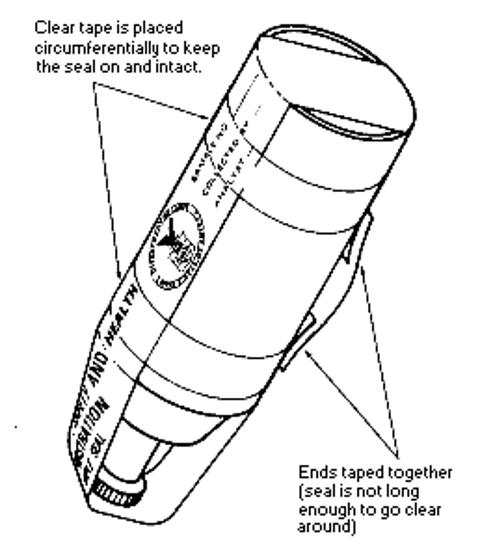
1-23
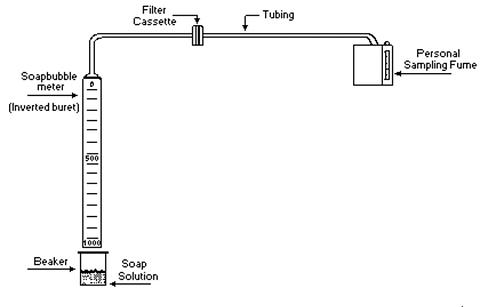
1-10
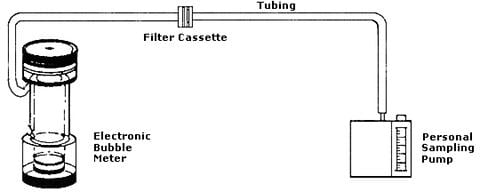
1-13
Ref. http://www.osha.gov/dts/osta/otm/otm_ii/otm_ii_1.html#asbestos


