
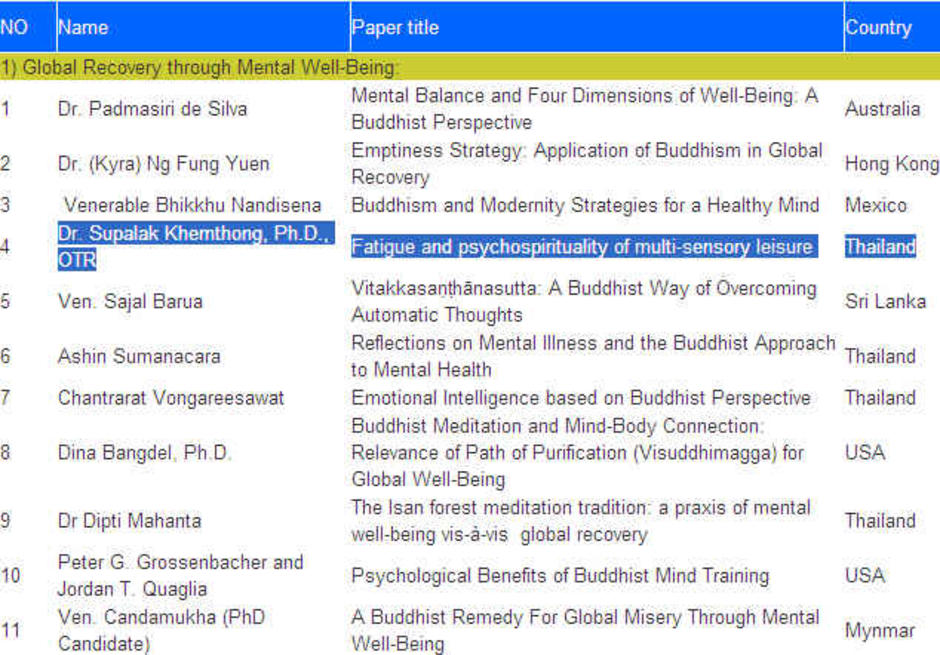
เวทีหนึ่งเป็นการเข้าร่วมวงเสวนากับผู้เชี่ยวชาญในงานประชุมวิสาขบูชาโลก ผมเป็นนักกิจกรรมบำบัดไทยคนเดียวที่จะนำเสนอผลงานชื่อ ความล้าและจิตวิญญาณของกิจกรรมยามว่างในความรู้สึกที่หลากหลาย จากกรณีศึกษาโรคข้อ โรคมะเร็ง และนักปฏิบัติธรรม ว่ามีความแตกต่างกันอย่างไร ผู้สนใจติดตามใน http://www.icundv.com/vesak2010/ ลองดูบทคัดย่อและบทความเต็มสามารถรับได้ที่งานประชุมหรือ website นี้หลังสิ้นสุดงานประชุม
Title: Fatigue and psychospirituality of multi-sensory leisure
Author: Dr. Supalak Khemthong, PhD, OTR
Correspondence: Faculty of Physical Therapy, Mahidol University, 999 Phuttamonthon 4 Road, Salaya, Nakhon Pathom 73170, Thailand. Phone: +66 (0) 2 441-5450 ext 20905 Fax: +66 (0) 2 441-5454 E-mail: [email protected]
Abstract
Introduction: Multi-sensory leisure for people with and without fatigue secondary to chronic conditions has been reported in term of mental well-being in daily livings. However, this is a new concept and implication for Thai people in the field of occupational therapy service. Therefore, small group discussion over 5 weeks had been conducted among an occupational therapist, a client with cancer (A), a client with rheumatoid arthritis (B), and a client preferred Buddhist and spiritual health (C).
Objectives: This pilot study aimed to understand fatigue and psychospirituality of multi-sensory leisure among Thai people.
Report: Fatigue management, programmed from previous studies, was introduced to 3 people with different backgrounds and health conditions. Under the circumstance of multi-sensory leisure, the structured exercises consisted of 5 sessions (2 hours per session, 1 session a week): fatigue in daily lives, banking energy, body communication, activity schedule, and balancing activity domains. Rating scale of self-efficacy (an indicator of psychospirituality from the least score of 1 to the most score of 10) was reported per participant after each session. Client A decreased feeling of physical fatigue and increased self-efficacy of fatigue management from 5 (1st session) to 8 (5th session). Client B decreased feeling of mental fatigue and increased self-efficacy of fatigue management from 4 (1st session) to 7 (5th session). Client C decreased feeling of cognitive fatigue and increased self-efficacy of fatigue management from 6 (1st session) to 8 (5th session).
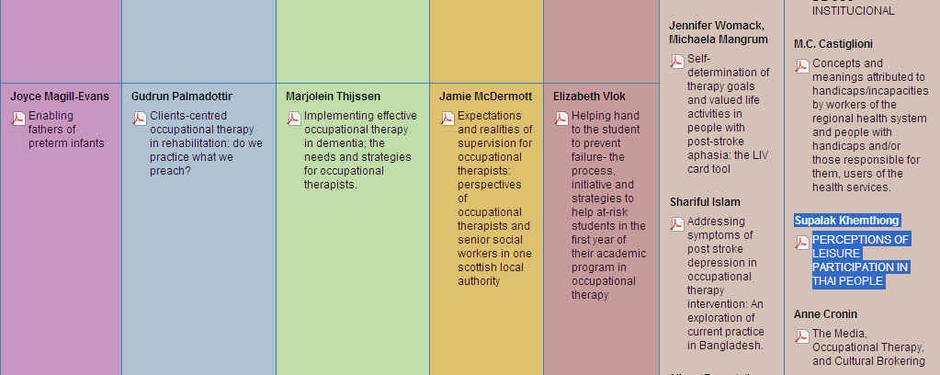
ผมนำบทคัดย่อมาแลกเปลี่ยนเรียนรู้ผู้สนใจ...ก่อนที่จะนำเสนอบนเวทีการประชุมนักกิจกรรมบำบัดโลกที่จัดขึ้นทุกๆ 4 ปี ในปีนี้ผมเป็นตัวแทนนักกิจกรรมบำบัดไทยไปนำเสนอผลงานชื่อ การรับรู้กิจกรรมยามว่างในคนไทย ณ ประเทศชิลี ผู้สนใจติดตามใน http://www.wfot.org/wfot2010/
0309
PERCEPTIONS OF LEISURE PARTICIPATION IN THAI PEOPLE
Supalak Khemthong
Mahidol University, Naknon Pathom, Thailand
Introduction: Positive relationship of leisure and health has been reported in occupation therapy
research, but different cultures influence occupation across life span as seen from the role of different
types of leisure associated occupational performance and health. Therefore, perceptions of leisure
participation in Thai people have been surveyed.
Objectives: This pilot study aimed to understand perceptions of leisure participation in three groups of
Thais including students, adults, and elders.
Methods: This study recruited 30 students, 30 adults, and 30 elders in both genders aged over 18.
The Classification of Leisure Participation (CLP) Scale - Thai healthy version was used. Participants
were asked to classify each activity representing mostly physical, social, creative, or passive leisure
and to report frequency of participation for each activity. The resultant dendrograms identified the
most representative activities for each type of leisure using Hierarchical Cluster Analysis. Frequency
of leisure participation per cluster was averaged for each group of the participations.
Results: Different dendrograms emerged from the three groups. Thai students and adults classified 2
clusters whereas elders classified 3 clusters. A clear perception of leisure participation was shown in
the elders (physical leisure) and in the adults (passive leisure). However, the rest of classifications
included a combination of physical, social, creative, or passive leisure. Maximal means of frequency
of leisure participation (days/week) were 3.49 + 0.73 for the students, 5.46 + 1.19 for the adults, and
3.17 + 1.09 for the elders.
Conclusion: Thai people may not have clear understanding about health benefits of leisure
participation; they then have perceived many combined types of leisure activities. Balancing
participation in those types is a key issue of good health across the ages.
Contribution to the Practice: Types of leisure participation appears to play different roles on culture,
age, and health. This has important implication for future practices of occupational therapy
interventions.



เป็นกำลังใจให้ครับอาจารย์
ขอบคุณมากครับสำหรับกำลังใจจากอาจารย์ เสียงเล็กๆ فؤاد
อาจารย์เอาความรู้กลับมาฝากพวกเราเยอะๆนะคะ
ยินดีอย่างยิ่งครับ แล้วจะนำความรู้มาฝากนักศึกษา OTMUรุ่น1 และทุกๆ รุ่น รวมถึงพี่น้องนักกิจกรรมบำบัดและคนไทยทุกคนครับ
ขอบคุณมากครับนศ.OTMUรุ่น1
ได้ทราบมาคร่าวๆว่ามีผู้ส่งบทความมาจากทั่วโลกและจากม.ที่มีชื่อเสียงระดับโลก แต่มีคนไทยส่งมาน้อย ขอแสดงความยินดีกับอาจารย์ Pop ที่เป็นคนไทยคนหนึ่งที่จะปรากฎตัวบนเวทีโลก "วันวิสาขบูชาโลก" ครั้งนี้...อนุโมทนาค่ะ
อ้อ เดี๋ยวจะหลงไหลได้ปลื้มกับวันวิสาขบูชาโลกจนลืม "วันวิสาขะบูชา" วันที่ 28 พ.ค. ๒๕๕๓ ด้วยนะคะ มีการจัดงานส่งเสริมพระพุทธศาสนาที่สนามหลวง ทีวัดอื่นๆในกทม.และทั่วประเทศด้วย ..ที่สนามหลวงคนไม่มากนักแต่จะมากันเรื่อยๆ ก็ดีนะเพราะจะได้ไม่เบียดเสียดกัน แล้วก็ระยะนี้ร้อนมากๆ เพราะผู้คนไปตามที่ต่างๆกันอันเนื่องด้วยการคมนาคมสะดวก เดี๋ยวผู้จัดงานจะน้อยใจและงบรัฐบาลหดสั้นลง ๆ น่าเสียดายและน่าเสียใจ .....ผู้คนบนโลกใบนี้เขาพากันยอมรับใน "คำสอนขององค์พระสัมมาสัมพุทธเจ้า" แต่รัฐบาลชาวไทยพุทธ "บ่ฮู้ บ่หัน"
จบงานวิสาขบูชาโลก ดิฉันก็จะไปที่สนามหลวงต่อค่ะและจะไปสวดมนต์ตอนเย็นร่วมกับพระภิกษุและพุทธศาสนิกชนอื่นๆด้วย ทำเช่นนี้เป็นประจำอยู่แล้วค่ะ
ชอบกระแทกแดกดันคนอื่นอยู่ล่ำไป ...เกิดมาผิดศาสนาหรือเปล่าหนอ!!!
ขอบพระคุณและอนุโมทนาบุญล่วงหน้าครับคุณอิสรีย์
Congratulations krub
อ.ป๊อป เก่งสุดยอดจริงๆ
ขอบคุณมากครับ Aj S