
อาจารย์วิบุล: 1x1 pixel ผมเก็ตครับ แต่ไม่อยากขยายต่อ ;-)
ความพยายามทุกอย่างถือว่าน่ายกย่องครับ แต่ปัญหาใหญ่คือระบบต้องใช้พลังงานมหาศาล แล้วเราจะไปหาพลังงานนี้มาจากไหน
จากหน้า 6 ของ paper Capturing Carbon Dioxide From Air:
We note that the CO2 content of a volume of air, as measured by the heat of combustion its removal could compensate for, is far larger than the kinetic energy the same volume of air would have assuming reasonable wind velocity. At 10 m/s, which is a wind stronger than is usually assumed to prevail in windmill operations [7], the kinetic energy of a cubic meter of air is 60 J, which should be compared to 10,000 J for the heat of combustion that would generate the CO2 content of a cubic meter of air. A windmill that operates by extracting kinetic energy from natural airflow needs to be two orders of magnitude larger than a CO2 collector that captures CO2 to compensate for the emissions from a diesel engine that generates the same amount of electricity. Since windmills appear economically viable, this suggests that the capturing
apparatus should not be too expensive to build.
One can pursue this line of reasoning a little further by looking at the same data in a slightly different fashion. Windmills are rated by energy flux per unit area. In effect the wind carries with it a flow of kinetic energy, a part of which a windmill transfers into electric energy. Thus a windmill at wind speed of 10 m/s would face an energy flux of 600 W/m2. The equivalent CO2 flux through the same area corresponds to 100,000 W/m2. Thus an air “filtration” system could extract CO2 from a stream that represents power generation of 100,000 W for every square meter of airflow. By this measure, CO2 is far more concentrated than the kinetic energy harnessed by
the windmill.
อ่านดูแล้วคงต้องแก้ปัญหากันอีกสักพักมั๊งครับ แต่ผมเห็นด้วยว่า carbon dioxide absorber ที่เหมาะที่สุด น่าจะเป็นมหาสมุทรครับ เลียนแบบที่ธรรมชาติเคยทำ; process ตามลิงก์ที่อาจารย์ให้มาน่าสนใจจริงๆ นะครับ
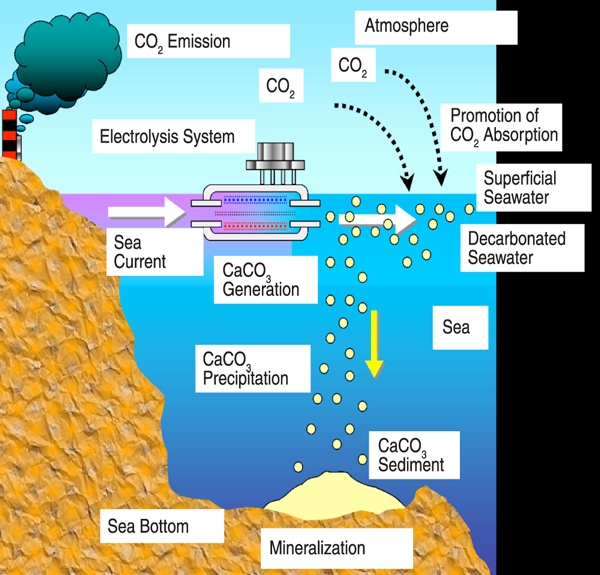
คงต้องดูเหมือนกันว่ากระบวนการ electrolysis นั้นจะทำให้ชีวเคมีของน้ำทะเลเปลี่ยนแปลงไปอย่างไร
อาจารย์บัวปริ่มน้ำ: นาโนเล็กกว่าอีกครับ