
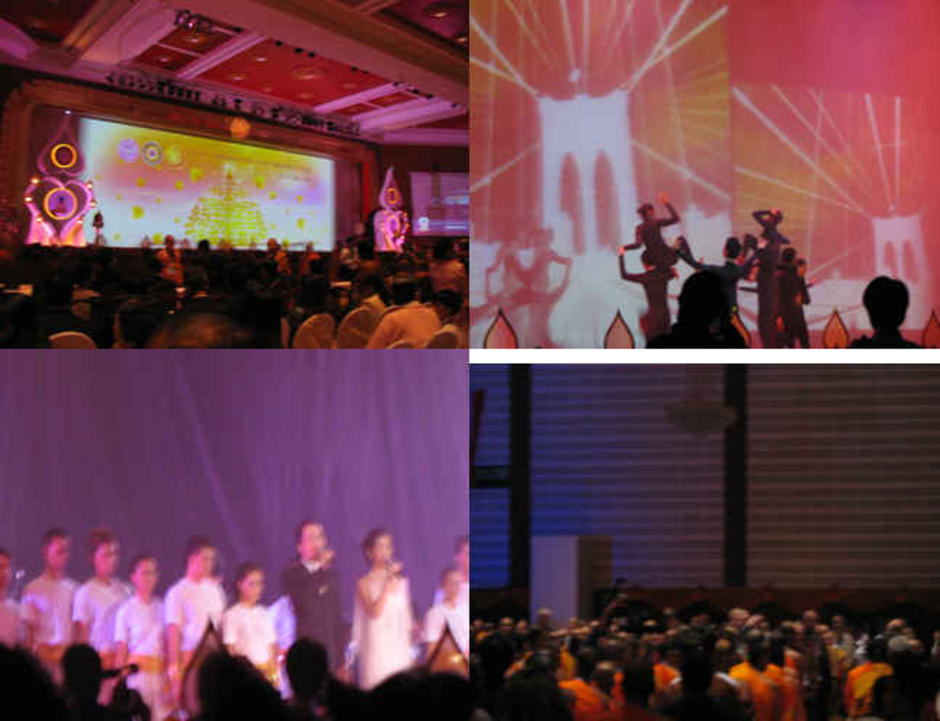
งานนี้มีพิธีเปิดที่แสดงต้นไม้แห่งปัญญา เกิดลมหายใจแห่งสันติภาพ รู้ ตื่น เบิกบาน เหนือกาลเวลา ปฏิบัติตามหลักคำสอนของพระพุทธเจ้าด้วยปัญญาและกรุณาเพื่อขจัดความทุกข์จากวิกฤติทางสังคมโลกและฟื้นคืนสภาพความสุขในมิติต่างๆ ซึ่งเป็นครั้งแรกที่ผมได้แลกเปลี่ยนเรียนรู้กับพระสงฆ์และนักวิชาการศาสนศึกษากว่า 1,600 คน จาก 84 ประเทศ และชาวญี่ปุ่นอีก 500 คน โดยเจ้าภาพ ม.มหาจุฬาฯ วังน้อย จ.อยุธยา ร่วมกับญี่ปุ่น
ผมอยากแลกเปลี่ยนเรียนรู้ในประเด็นที่นักวิชาชีพกิจกรรมบำบัดซึ่งเป็นวิชาชีพเพื่อพัฒนาทักษะชีวิตและคุณภาพชีวิต อาจมองข้ามประเด็นที่พระสงฆ์และนักวิชาการศาสนศึกษาที่ได้ทบทวนวรรณกรรมและวิจัยเชิงพรรณนา/คุณภาพจากหลักคำสอนของพระพุทธเจ้าแล้วนำองค์ความรู้มาบูรณาการเชิงความคิดเพื่อช่วยเหลือและพัฒนาสุขภาวะทางจิตสังคม โดยยังไม่มีงานวิจัยทางการแพทย์เชิงทดลองทางคลินิก/เชิงปริมาณกับผู้ป่วยทางจิตสังคมมากนัก
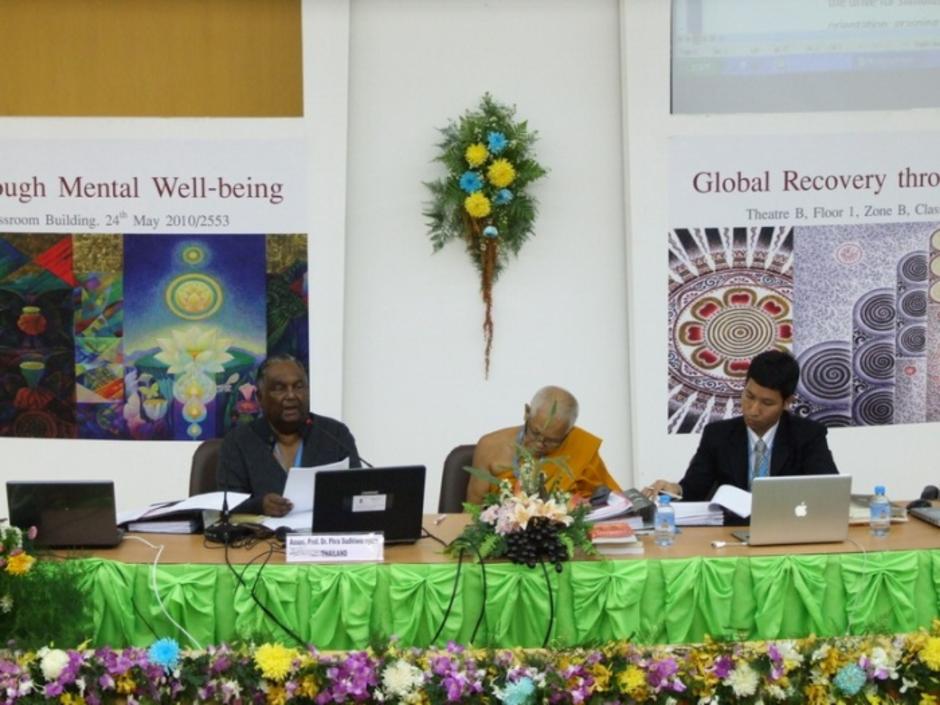
ประเด็นหลักที่น่าสนใจและชวนให้คิดต่อยอดความรู้ ได้แก่
- การตรวจสอบความสัมพันธ์/ความสมดุลระหว่างจิตใจและร่างกายที่มีกระบวนการพัฒนาความสุข ความมั่นใจในการใช้ชีวิต และความสำเร็จในการเป็นมนุษย์
- การทำความเข้าใจถึงความรู้ทางการแพทย์ที่ศึกษากลไกทางจิต การบำบัดอาการทางจิตโดยการฝึกฝนความรู้ความเข้าใจ ความคิดแบบอัตโนมัติ ความคิดผ่านจิตสำนึก ความคิดที่ส่งผลต่อการปรับพฤติกรรม ความคิดผ่านสมาธิแบบต่างๆ ความคิดผ่านการสนทนาธรรม ความคิดผ่านโปรแกรมการจัดการเชาวน์อารมณ์
- การทำความเข้าใจคนที่มีสุขภาพจิตที่ดีและไม่ดี และส่งผลถึงคุณภาพชีวิตทางร่างกาย สังคม จิตใจ และจิตวิญญาณ
- การทบทวนความรู้สึกทุกข์สุข ความคิด/ความรู้ความเข้าใจในการจัดการความรู้สึกต่างๆ และการรับรู้สุขภาวะหรือทุกขภาวะด้วยสติ เน้นหลักคำสอนเมตตา กรุณา มุฑิตา และอุเบกขา รวมทั้งอริยสัจสี่ - ทุกข์ สมุทัย นิโรค มรรค และปฏิบัติหลักมรรค 8 เป็นต้น
- การอธิบายพุทธศาสนาต่อการสร้างสุขภาวะทางจิตยังต้องใช้เวลาในการศึกษาข้อเท็จจริงอย่างลึกซึ้ง และมีการแลกเปลี่ยนเรียนรู้กับผู้เชี่ยวชาญทางการแพทย์ การศึกษา และศาสนาศึกษา ให้เห็นถึงรูปธรรมของกรอบความคิดสู่การปฏิบัติที่แท้จริงในสังคม
- ผมเองก็ได้เรียนรู้ในการประยุกต์โปรแกรมการจัดความล้าจากการศึกษาผู้ป่วยชาวออสเตรเลียให้มาใช้ในคนไทยด้วยระยะเวลาและเนื้อหาที่เน้นพุทธปฏิบัติ การวิเคราะห์กิจกรรมบำบัด การสงวนพลังงาน และการบูรณาการจิตวิญญาณ (การสังเกตธรรมชาติพร้อมการรับรู้ความรู้สึกและประสบการณ์แห่งสุขภาวะ) ที่หลากหลายของตนเองในเวลาว่าง ภายใน 5 สัปดาห์ ในสามกรณีศึกษาที่เป็นมะเร็ง, โรคกระดูกและข้อ, และมีความเครียดและปฏิบัติธรรม ทำให้พวกเขาเหล่านี้มีความเชื่อมั่นที่สามารถจัดการความล้าด้วยตนเอง เปรียบเสมือนการเรียนรู้สภาวะจิตและกายของตนเองผ่านแรงจูงใจกับการบูรณาการจิตวิญญาณตามแนวคิดทางพุทธศาสนา (อริยสัจสี่) และกิจกรรมบำบัด
- ผมรู้สึกว่า งานวิจัยทางคลินิกของผมอาจไม่เป็นที่คุ้นเคยกับชุมชนแห่งการเรียนรู้พุทธศาสนามากนัก แต่ก็ประทับใจที่ได้เผยแพร่มุมมองที่ผมถนัดผ่านผู้ฟังที่พิเศษอีกกลุ่มหนึ่งที่ให้คำถามผมไปต่อยอด คือ การนำธรรมะไปใช้ในผู้ป่วยอย่างสำเร็จเป็นเรื่องที่พิสูจน์ได้เสมอไปทุกผู้ป่วยหรือไม่ ผมตอบว่า ไม่เสมอไป ขึ้นอยู่กับความต้องการ พื้นฐานความคิด พื้นฐานสุขภาวะทางจิตสังคม และประเภท/ลักษณะความเจ็บป่วยในกลุ่มที่ไม่ควรจัดโปรแกรมตามผู้บำบัดมากนัก และจำเป็นต้องมีการศึกษาวิจัยเชิงคลินิกในแต่ละกลุ่มเพื่อพิสูจน์ประสิทธิผลและประสิทธิภาพที่แท้จริงมากกว่าการศึกษาเชิงพรรณนา/ปรัชญาอย่างเดียว
เมื่อวานผมได้เข้าร่วมฟังบทสรุปปฏิญญากรุงเทพมหานครว่าด้วย "พุทธศาสนาจะฟื้นสภาพวิกฤตทางธรรมชาติ นิเวศวิทยา และจิตสังคมอย่างไรเพื่อสุขภาวะทางจิตและความกลมกลืนของการมีส่วนร่วมของชาวพุทธทั่วโลก"
ผมเพิ่งทราบว่าพุทธศาสนาแบ่งเป็นสามนิกายหลักๆ ได้แก่ Theravada, Mahayana, Vajayana แต่ได้เน้นถึงหลักคำสอนของพระพุทธเจ้า เช่น สัมมาฐิติ เพื่อ
1. สื่อสารและสร้างสัมพันธภาพระหว่างคนที่มีวัฒนธรรมและการศึกษาอันหลากหลายให้เกิดการพัฒนาสุขภาวะทางร่างกาย จิตใจ สังคม เศรษฐกิจ และจิตวิญญาณ (ความคิดที่มีสติและรู้คุณค่าในการกระทำเพื่อแก้ไขปัญญา/ลดความขัดแย้งในตนเอง-ผู้อื่น)
2. สร้างสมดุลย์แห่งความรู้ความเข้าใจทางจิตใจและปัญหาสุขภาพจิตในสังคม โดยเฉพาะการจัดการอารมณ์แห่งความทุกข์ เช่น โกรธ กลัว เกียจ หลง โลภ รัก เป็นต้น ซึ่งเราควรพิจารณาจากการสังเกตสิ่งต่างๆรอบตัวให้เข้าใจความจริง คุณธรรม และความรัก ที่ส่งผลต่อการควบคุมอารมณ์ ความคิดอัตโนมัติ จิตวิเคราะห์ที่มีหรือไม่มีการประเมินตนเองในแต่ละสถานการณ์ชีวิต เช่น การจัดการความขัดแย้งเพื่อลดความเห็นแก่ตัวแล้วยอมรับความหลากหลายของคน-สิ่งแวดล้อม ตลอดจนนำพลังมวลชนเพื่อมีส่วนร่วมแก้ไขปัญหาทางสังคมอย่างจริงจังและจริงใจ
3. สร้างกลไกทางการศึกษาเพื่อให้ทุกคนเห็นคุณค่าของการฝึกคุณธรรมและจริยธรรมในตนเอง สอนตนเองให้เข้าใจชีวิตกับการปรับตัวต่อธรรมชาติที่เปลี่ยนแปลงและวัฒนธรรมที่แตกต่างกันจนส่งผลกระทบต่อปัญหาทางสังคม
4. ความกลมกลืนและความยั้งยืนแห่งพุทธศาสนาช่วยนำความสุขและความสงบในการเพิ่มแรงจูงใจและการปฏิรูปกลยุทธ์ในการแก้ไขปัญหาสุขภาพและสังคม ทั้งนี้ชาวพุทธควรมีส่วนร่วมทำกิจกรรมเพื่อสังคมมากขึ้น และสร้างเครือข่ายความร่วมมือช่วยเหลือสังคมโดยกิจกรรมสอนพุทธศาสนาเพื่อสร้างสรรค์ธรรมชาติ อาหาร อากาศ เทคโนโลยี และอื่นๆ


ขอบคุณคุณยงยศสำหรับข้อความที่ดีมากๆ โดยท่าน ว.วิชรเมธี
ห้องที่ชื่อว่า "ใจ"
ใจ ของเรานั้น
ไม่ต่างอะไรกับห้องที่ว่างเปล่า
เมื่อเราใส่อะไรเข้าไปในห้องที่ว่างเปล่านั้น
สถานภาพของห้องก็จะเปลี่ยนไปทันที
เป็นต้นว่า
เรามีห้องว่าง
เปล่าอยู่ห้องหนึ่ง
เมื่อ
เราใส่น้ำเข้าไป ก็จะกลายเป็นห้องน้ำ
เราใส่พระพุทธรูปเข้าไป ก็จะกลายเป็นห้องพระ
เราใส่เครื่องมือปรุงอาหารเข้าไป ก็จะกลายเป็นห้องครัว
เราใส่เครื่องนอนเข้าไป ก็จะกลายเป็นห้องนอน
เราใส่ชุดรับแขกเข้าไป ก็จะกลายเป็นห้องรับแขก
เราใส่บุคคลสำคัญเข้าไป ก็จะกลายเป็นห้องวีไอพี
ห้องแห่งหัวใจของเรา
ก็ไม่ต่างอะไรกับห้องว่างเปล่าที่กล่าวมาข้างต้นนั้นเลย
ทุกครั้งที่เราบรรจุอะไรเข้าไปในใจ
ใจของเราก็จะเปลี่ยนสถานภาพเหมือนกัน
เราใส่ความเมตตาเข้าไป ก็จะกลายเป็นคนใจดี
เราใส่ธรรมะเข้าไป ก็จะกลายเป็นคนใจบุญ
เราใส่ความโกรธเข้าไป ก็จะกลายเป็นคนใจร้อน
เราใส่ความเลวเข้าไป ก็จะกลายเป็นคนใจทราม
เราใส่ความกลัวเข้าไป ก็จะกลายเป็นคนใจเสาะ
เราใส่ความเป็นนักสู้เข้าไป ก็จะกลายเป็นคนใจสู้
เราใส่ความขาดสติเข้าไป ก็จะกลายเป็นคนใจลอย
เห็นด้วยหรือไม่ว่า
ใจของเรานั้นเป็นสิ่งที่มีอิทธิพลเหนือกาย
เป็นสิ่งที่คอยออกแบบชีวิตของเราให้เป็นไปอย่างไรก็ได้
พระพุทธเจ้าเคยตรัสว่า
ใจเป็นนาย ใจเป็นผู้นำ ใจเป็นผู้สร้างสรรค์ ...
หรือบางทีก็ตรัสว่า จิตฺเตน นียติ โลโก
แปลว่า โลกหมุนไปตามใจสั่งการ
โลกในที่นี้ หมายถึง ชีวิตของเรานั่นเอง
โลกคือชีวิต จะหมุนซ้าย หมุนขวา หมุนตรงหรือหมุนเอียง หมุนไปข้างหน้า หรือว่าหมุนไปข้างหลัง
ทั้งหลายทั้งปวงนั้นขึ้นอยู่กับพฤติกรรมของใจทั้งหมดทั้งสิ้น
ใจของเราไม่ต่างอะไรกับห้องที่ว่างเปล่า
เราบรรจุอะไรลงไป
ชีวิตของเราก็เป็นไปตามสิ่งที่บรรจุนั้น
ทุกวันนี้ เราเคยถามตัวเองบ้างไหมว่า
เราบรรจุอะไร
ลงไปในห้องแห่งหัวใจของเราบ้าง
ความรู้ ความงมงาย
ความรัก ความโกรธ ความเกลียด
ความโลภ ความดี ความชั่ว
ความริษยา ความหน้าด้าน ความสะอาด
สว่าง สงบ หรือความตื่นรู้
ชีวิตจะเป็นอย่างไร
รุ่งโรจน์หรือร่วงโรย
ขึ้นสูงหรือลงต่ำ
สำคัญที่เราบรรจุอะไรลงไปในใจของเราเอง ...
ว.วชิรเมธี
Vesak Bangkok Declaration 2010
Bangkok Declaration The Seventh International Buddhist Conference
on The United Nations Day of Vesak May 23-25, 2010 (B.E.2553)
Bangkok Declaration
The Seventh International Buddhist Conference
on The United Nations Day of Vesak
May 23-25, 2010 (B.E.2553)
at the Mahachulalongkornrajavidyalaya University Main Campus,
Wang Noi, Ayutthaya, The United Nations Conference Centre, Bangkok and Buddhamonthon, Nakhon Pathom Province, Thailand
With full reference to the resolution approved on 15th December 1999 by the General Assembly of the United Nations, Session No. 54, Agenda Item 174, a joint proposal by representatives from 34 countries, that Vesak, which falls on the Full Moon day in the month of May, be internationally recognized and observed at the United Nations Headquarters and its Regional Offices from the Year 2000 onwards, The United Nations Day of Vesak will be jointly celebrated by all Buddhist traditions;
Furthermore, having consolidated mutual understanding and cooperation amongst all Buddhist traditions, organizations, individuals, other spiritual traditions and civil society through ongoing dialogue;
Having decided to disseminate the following message of peace based on the Buddha’s teaching of wisdom and compassion;
Having explored the Buddha’s teachings to aide and sustain global recovery;
We, the participants from 83 countries and regions of the International Buddhist Conference on the United Nations Day of Vesak convened at the Mahachulalongkornrajavidyalaya University Main Campus, Wang Noi, Ayutthaya, The United Nations Conference Centre, Bangkok and Buddhamonthon, Nakhom Pathom Province from May 23-25, 2010 (B.E. 2553), gratefully acknowledging that the Conference has been generously hosted by Mahachulalongkornrajavidyalaya University of Thailand and The Inner Trip Reiyukai International, ITRI, of Japan, supported by the Royal Government of Thailand under the guidance of the Supreme Sangha Council of Thailand, have unanimously resolved the following:
(1) to reiterate once again the sheer impact of the man-made global banking and economic crisis on every community and nation and how a human’s states of mind influence his actions which in turn affect his environment; and to re-affirm our efforts towards filling the spiritual vacuum by emphasizing the natural law of inter-being that will help sustain the fragile global recovery;
(2) to encourage, as part of Buddhist contribution towards global recovery, the world community to introduce humanistic education in order to promote human dignity, security and social and economic solidarity on the one hand and on the other to minimize self-inflicted problems in the world; and to urge world religious and political leaders to strengthen ongoing dialogue in order to avoid mistrust and violence between different cultures;
(3) considering that every big crisis starts out as a small crisis, the escalation of which is not inevitable if we manage to understand the causal chain of events which produces it, to develop peaceful social strategies based on the Middle Path in prevention, resolution and healing through non-violent and tolerant communication, participation and interdependence for harmonious existence;
(4) to promote mental and emotional welfare and wellbeing of mankind through moral ethics, meditation, self-evaluation, self-awareness and right view as well as to highlight the danger to the society of egoistic states of mind and the benefit of service to the wider society;
(5) to use socially engaged Buddhism in various fields as guided by the Dhamma as a tool in order to help relieve the impact of global economic crisis on individuals and communities;
(6) to promote awareness on the interlinkages between Buddhism, ecology and attitudes to nature; and to endorse a global “eco-Buddhist” network;
(7) to endorse the creation of World Buddhist Park by the World Buddhist Park Foundation in Prachin Buri Province, Thailand as a further development of the Centre of World Buddhism, as internationally endorsed in 2005/ 2548, at Buddhamonthon, Nakhon Pathom Province, Thailand;
(8) to continue promoting better understanding of Buddhist principles amongst the wider public by compiling and distributing widely a common Buddhist text, which will reflect the rich resources of the Theravada, Mahayana, and Vajrayana Buddhist traditions as well as the needs of today’s society;
(9) to continue supporting the ongoing electronic project for a Union Catalogue of Buddhist Texts, UCBT, which is currently being carried out by leading scholars from 23 universities and libraries from 16 nations, by hosting a seminar at Mahachulalongkornrajavidyalaya University in September 2010;
(10) to hold the second conference of the International Association of Buddhist Universities, IABU, in December 2011/ 2554 under the theme of Buddhist Philosophy and Praxis at Mahachulalongkornrajavidyalaya University;
(11) to hold the 2011/2554 United Nations Day of Vesak at the Mahachulalongkornrajavidyalaya University Main Campus, Wang Noi, Ayutthaya, The United Nations Conference Centre, Bangkok and Buddhamonthon, Nakhompathom Province, Thailand, so celebrating the Auspicious Occasion of His Majesty King Bhumibol Adulyadej’s 84th Birthday Anniversary December 5, 2010.
Dated: 25th May 2010/2553.
Retrieved at http://www.icundv.com/vesak2010/
Summary Report Mental Well-being
Buddhism, is often, the subject of the minds, working on the mind – a favorite topic for scholars to teach. Some author’s too the term: well-being, and assumed it was referring to medical or mental health issues, and wrote pertaining to this interesting topic; however many authors should learn more about the medical-neuro-sciences, because now, just echoing abhidhammic material is not enough to explain in the modern era. There is a lot of deep reading material in this session – contemplating the higher offerings will benefit Buddhist studies for years.
Core Ideas
• Mental imbalances and illnesses are more affected by the mind than the external physique; thus, suffering can be controlled by the mind.
• Mental imbalance leads to decline in both physical and mental health.
• That awareness of factors that cause suffering will moderate and exterminate suffering.
• Anger, fear, hatred, envy, delusions, and excessive desires are the root cause of all suffering and mental imbalances.
• Mental well-being can only be achieved by complimenting understanding with practice.
• That practicing the five precepts, observing morality and upholding truth, virtue, and love will promote better well-being.
• That thoughts is followed by emotions, and falling for automated thoughts without evaluation practice enslaves human beings and society to impertinence thoughts and negative thoughts
• That suffering is a cycle that can be broken only by mental practice to minimize the sense of needs.
Suggestions
• Constant practices of Samadhi and Samma-Samadhi
• Buddhist Chanting and music of the same tone in order to spread the benefits to children
• Practicing self-evaluation and self-awareness
• Communication and community sharing of Buddhist mental cognition
• Practice of Buddhist mental cognition, which includes awareness and analysis
• Acceptance of dukkha and an impermanent state
• Living in harmony with nature and becoming aware of needs
• Avoiding anger, delusion, and needs
• Follow the Five Precepts and the Eight Folded Path
• Promoting the concept of letting go
• Promoting sense of interconnectivity
• Promoting metta
Retrieved at http://www.icundv.com/vesak2010/node/1032